In the “olden days” (which to today’s generation probably means before TV), when there were no street lamps or lighted guppy aquariums, and people used candles or torches to find their way at night, the sky could get very dark indeed. Especially when the moon was less full or on the other side of Earth, night was a time for many to look up and wonder at the immensity of the universe. Without “light pollution” in the sky, many more stars were visible to the unaided eye than we can see today near any civilization. So many, that in the Old Testament, when God promised Abraham his descendants would be innumerable as the stars, it boggled Abraham’s mind. Yet he believed the unbelievable, and became known as an example of faith.
In Greek lore before Christ, in Arabic lore before Mohammed, and in the ancient religions of many cultures, the luminous heavenly bodies played important parts in the drama of life. In those days, science and superstition were intermingled, and religion pervaded every experience and touched each object. The ancients traced the path of “fixed” stars as they, like the moon and sun, traveled roughly from east to west. As the earth turns, these stars appear to curve in a crescent path as they pivot around Polaris, the North Star.
In the northern sky, the Big Dipper in winter starts off standing on its handle, the far edge pointing toward Polaris. By spring, when it’s pleasant enough to go out onto the lawn at night in robe and slippers, the Big Dipper has turned bottom-side-up with the handle pointing southeast, but the two stars on the edge still point to Polaris. The North Star is not the easiest to find-even when the pointers are not hiding behind the trees close to the horizon. But from my front porch, it’s right over the mailbox and the corner of my dog yard.
At least three star groups or constellations deal with dogs, and I’m sure you can think of two of them. Before getting into that, I want to answer a question you may not have thought to ask as yet: what about the planets? Stars take the same paths every day (every time the earth rotates), with minor changes in position made over a period of thousands of years. They are flaming suns in their own systems and galaxies, while the planets around our own sun reflect its light instead of generating their own. As the moon circles Earth and appears “in” different star constellations at different times, so do the planets as they circle the sun with varying “years” in their own time schemes. That bright “star” you see, even when it’s not really dark, such as after dawn or in early evening may not be a star at all, but Venus or Jupiter, and they may be there in different months of different years. Mars may be about the only other planet you’ll see with the naked eye, especially if you live near city light pollution.
The dog-related stars are mainly visible to Americans from late fall to early spring, when there are more hours of darkness. In summer, by the time the sun sets, these have already begun to show themselves to the Hawaiians and Japanese and will not come around again at night until November. Crisp winter nights with no clouds may be best for viewing the more recognizable stars, including those involving dogs.
Orion
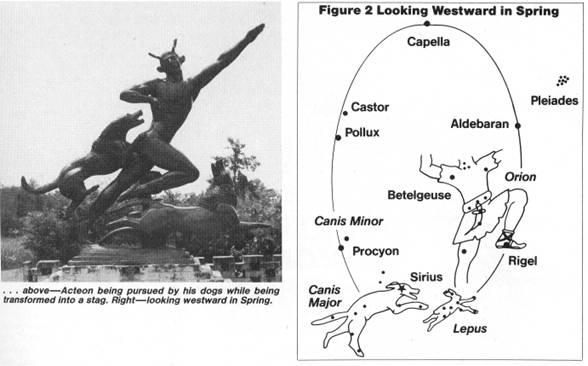
Let’s look at the late fall sky first. Being a confirmed warm-weather aficionado since I moved from the “Arctic Circle” (the Michigan-Ohio border), I dread the day I first see Orion rising over the eastern horizon. It foretells the dark, cold months ahead. It is then that the mighty hunter starts off lying on his back, the three bright jewels on his belt in a nearly vertical (east-west) line. By the time the rest of his form is visible in the contrast of the darkening sky, Sirius can be seen to his right and rear. A little later you can identify the other major stars in a large semi-circle around Orion’s top half, even with the belt, starting on the horizon from a little to left and sighting clockwise until you end at Orion’s uplifted foot (see illustration). Off to the side of the reddish-tinged Aldebaran is a fuzzy cluster which, with binoculars, becomes a septet of diamonds – the Pleiades.
As spring arrives, the best viewing of Orion and his stellar halo is had by looking westward after sunset. He now stands on the western horizon with his star-studded belt horizontal (north-south). You will easily find Sirius at dusk, but the rest of the neighbors are not visible until it gets darker.
Canis Major
Sirius is the brightest star in the sky and for a good part of the year is the “first star I see tonight”. Popularly known as “The Dog Star”, it has been associated with Canis familiaris almost since the beginning of history and among many cultures. The Greeks fancied Sirius as the head of a great dog (the constellation Canis Major) which stands on his hind feet ready to pounce on Lepus the hare. Incidentally, Lepus is the origin of the Easter Bunny, and is related to spring and pagan resurrection symbolism from long before Christ. The Arabians also thought of the constellation as Al-Kalb-al-Akbar, “the Greater Dog”. In India it was the dog “Deerslayer”, and the stargazers of the Euphrates knew it as “Dog of the Sun”. The Egyptians, who worshipped Sirius and built temples in its honor, did so because this watchdog’s annual appearance announced the time of the Nile’s flooding. The overflow brought fertility and nourishing water to farmlands, providing for another harvest.
This great star, visible from every inhabited region of Earth, is only 8.6 light-years away. That’s about half a million times farther than our sun, but being twice the diameter of Sol, it is 27 times more luminous. Since it is considered younger than the Sun, Sirius is much hotter, probably 20,000°F. Only astronomers with very powerful telescopes can see that the light actually comes from a double star, Sirius A and its small “white dwarf” companion, which revolve around a common center of gravity.
As Summer progresses, the Dog Star rises soon after the sun and closely follows or “dogs” it through the hottest days of the season. This gave rise to the phrase “dog days” as much as did the notion that dogs go mad more easily in late summer. Toward the end of January, Sirius rises in the east about the time the sun sets in the west, and by late spring it sets before dark. So the best time to view Sirius is from mid-November to mid-spring.
The star is a brilliant bluish-white today, but early Babylonian, Greek, and Roman manuscripts currently under study at Ruhr University in West Germany indicate it was once more red. Ptolemy, Cicero, Seneca, and others mentioned its ruddy hue, and ancient Romans sacrificed red-coated dogs to Sirius. Gregory of Tours in the Sixth Century reported that it was called Rubeola, which means red or rusty. The most likely explanation for this “sudden” (cosmically speaking) change is that Sirius B was a red giant that collapsed to a white dwarf, a common event in the aging process of stars, though not usually thought to be accomplished very quickly.
A Greek legend has it that Aurora gave a swift dog to Cephalos, who raced it against the fox. The dog did so well against his speedy cousin for such a great distance that Jupiter, the king of gods, was pleased. Therefore he placed it in the sky as its reward. Some Egyptologists say that the chief deity Osiris and the star Sirius are derived from the same root word. A son of Osiris named Anubis was often pictured in the hieroglyphics as having a dog-like head (most likely a jackal), and when Isis searched for Anubis, she had a dog’s assistance. Whatever Canis Major was called in the earliest pagan religions, it represented the qualities of speed, fidelity, protection, and mental agility-qualities we like to attribute to our dogs today.
Canis Minor
You really must have a vivid imagination, or be willing to believe what you are told, to visualize any of the supposed figures outlined by the constellations other than the Big Dipper or possibly Orion. This is especially true when someone tells you that a fairly bright star and a faint one close by form the outline of a little dog, Canis Minor. Playing follow-the-dots shows me nothing but a short, straight line, but who am I to deflate legends, especially if they make stargazers think about dogs? The constellation, which with the help of binoculars can be seen to have about five or six very faint stars associated with it, contains the first-magnitude star Procyon. This means “before the dog”. Remember “Cynologique” means “dog study” in the FCI organization’s name, and –cyon appears in many Latin zoological names for “canines”, which also stems from the same root.
Procyon rises in the east just before Sirius, although because of the trees in our valley, we always see Sirius first. Here, Procyon sets two or three hours after Sirius does. Early Romans called it Catellus, which means “puppy.” In earlier Greek mythology, Canis Minor was Helen’s dog, and went with her when she was abducted by Paris. Other cultures attached canine symbolism to these two stars as well: in the Euphrates valley it was a water dog, and elsewhere it is referred to as one of the hunting dogs of Orion. Another legend says that it was a hound belonging to Actaeon: when the goddess of the hunt, Diana, transformed Actaeon into a stag, the dog devoured its master. Could this be the origin of all those silly misconceptions of certain breeds turning on their masters?
Procyon, the herald of the Dog Star, has one-third the brightness of Sirius, yet is actually eight times as luminous as our sun. At 9.5 light years it is really one of our Solar System’s nearest neighbors. A slight yellow tinge (astronomers can see this; I can’t) shows its age to be between that of young Sirius and older Sol, our maturing yellow sun.
The Little Dog is easily located, not only because of Procyon’s brightness, but also because it forms a nearly equilateral triangle with Sirius and Betelgeuse. Another triangle is formed with Betelgeuse and Pollux. On winter evenings look for it to your left as you face Orion in the east. As spring approaches, after darkness falls, look for Sirius in the south-south-west, then Procyon higher and a bit more to the west. Following the circle northward, you’ll find the Gemini twins, Castor and Pollux.
Gemini
While not, strictly speaking, related to dogs in legend, the constellation Gemini is included in my thoughts because its two principal stars figure in the history of the German Shepherd Dog. Their namesakes, Castor and Pollux, are two of the late 19th Century foundation animals to which all GSDs alive today trace their ancestry. When you find Orion on winter evenings, trace a line from Rigel on the right through the belt, on through Betelgeuse, and it will point toward Gemini in the northeastern sky. Castor was once known by the ancients as the brighter of the pair, but now it is Pollux that is the greater light. Castor is actually made up of three stars.
Next time your house dog has to go out one last time before letting you get a night’s sleep, look up at the stars. If it’s between Thanksgiving and Easter, and you don’t live in a cloud-covered or light-polluted area, you should be able to see Orion with his dogs and the great circle of bright stars. I guarantee that your pooch won’t think you’re crazy if you call out their names, but he might wonder about you if you tell him that Pluto is also out there somewhere in the dark.